

The history. Commercially viable electric motors arrived in the 1880s. Factory productivity didn't move until the 1920s. Thirty to forty years. Economic historians (Paul David's dynamo research is the classic) traced the delay to one mistake: factories bolted the new engine onto the old architecture.
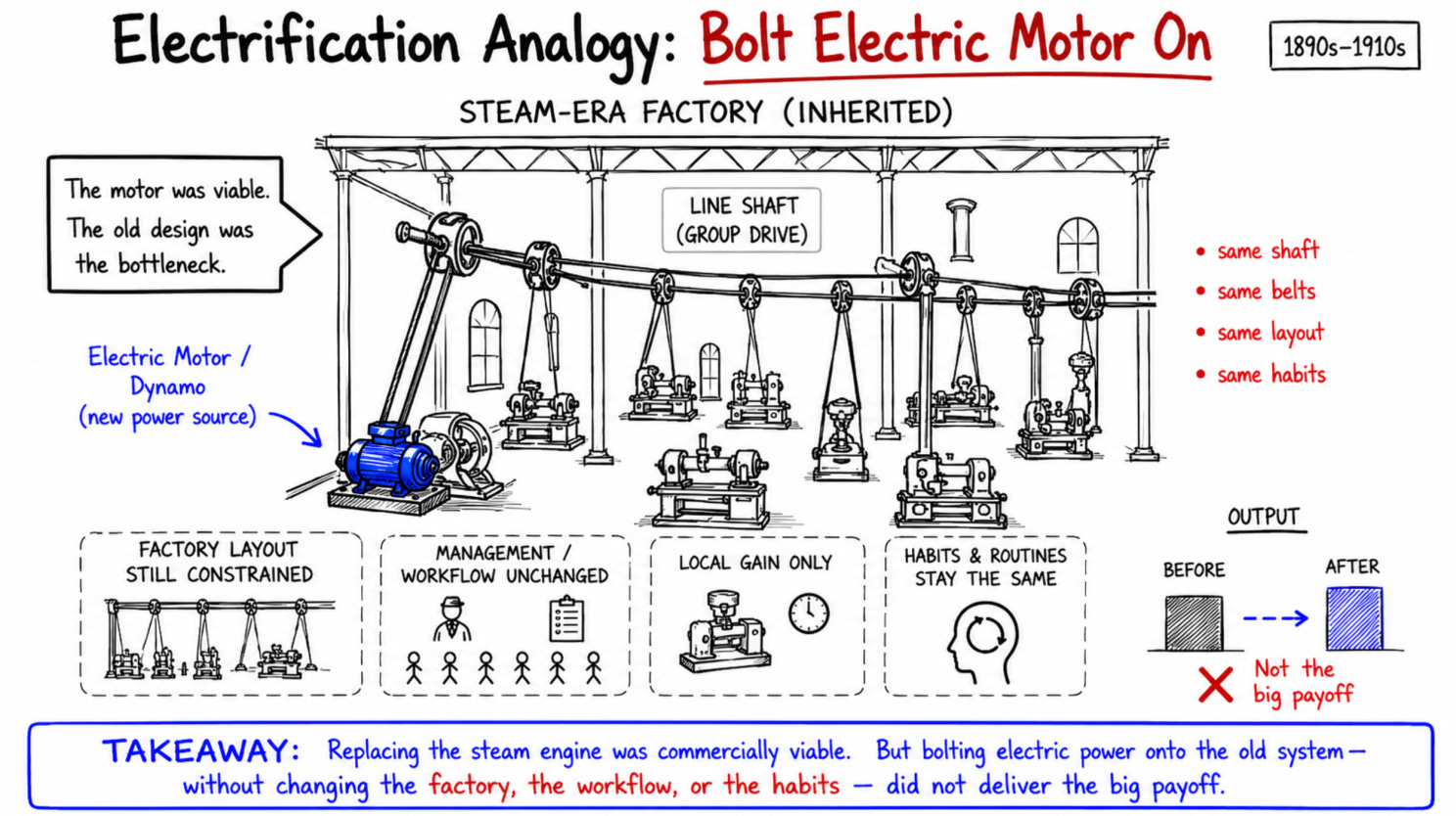
Steam factories were built around a single power source: one engine turning an overhead line shaft, belts dropping to every machine, layouts dictated by power instead of workflow. When electricity arrived, owners swapped the steam engine for one big electric motor on the same shaft. Same layout, same belts, same everything. Result: marginally cheaper power, flat productivity. A 2x mindset.
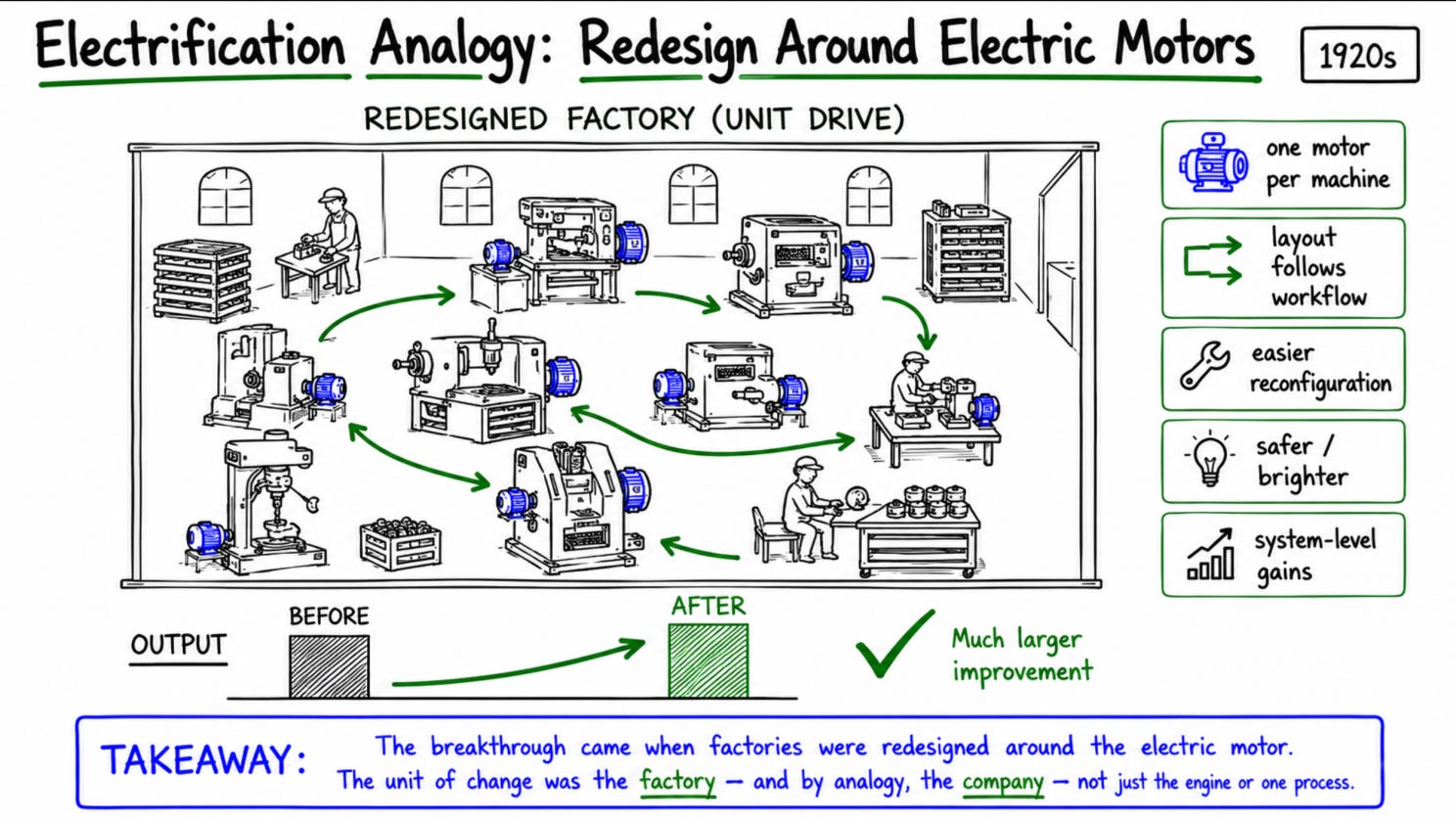
The real unlock was that electric power could be distributed. A motor on every machine (”unit drive”) made the shaft unnecessary, and everything the shaft dictated became negotiable. Factories went single-story, machines were arranged around the flow of work, downtime collapsed, and the assembly line became physically possible. That redesign, not the motor, drove the 1920s productivity boom.
Why thirty years? Sunk capital in existing factories. A generation of engineers whose expertise was optimizing the old architecture. And a hard truth: the gains couldn’t be captured machine-by-machine. The factory was the unit of change. Mostly, new factories built from scratch got there first.
Today’s line shafts aren’t steel. They’re process: handoffs, ticket queues, role definitions, reporting structures, all built around the old constraint that human attention was the only engine. Bolt AI onto that and you get real but incremental gains, which is why the corporate AI conversation keeps collapsing into “how much headcount can we save?” Cost savings on personnel is the 2x paradigm. And just like 1895, the company, not the tool or the department, is the unit of change.
The Rosenblatt thesis. Rosenblatt is an AI engineering services firm built on one decision: we are the factory being redesigned around the engine, not a firm bolting it on. Concretely:
Outcome & product focused. Every engagement runs on KPIs and North Star metrics that tell us objectively whether AI is making the work better or worse.
Engineers out-compete via compounding internal platform. Our engineers work on an internal platform that compounds with every engagement, making each Rosenblatt engineer distinctly more capable than an equivalent engineer alone.
Opportunity over headcount arithmetic. With startup clients shipping AI MVPs and mid-market clients standing up pilots, we optimize for what AI unlocks, not what it replaces.
Full ownership top to bottom. We recognize the dangers posed by over-reliance on suppliers & runaway token expenses, the company is built for full cost control.
An individual lacks the team dynamic, an enterprise is too rigid. A single team iterating is the beginning, which can be scaled up iteratively through success and failure.
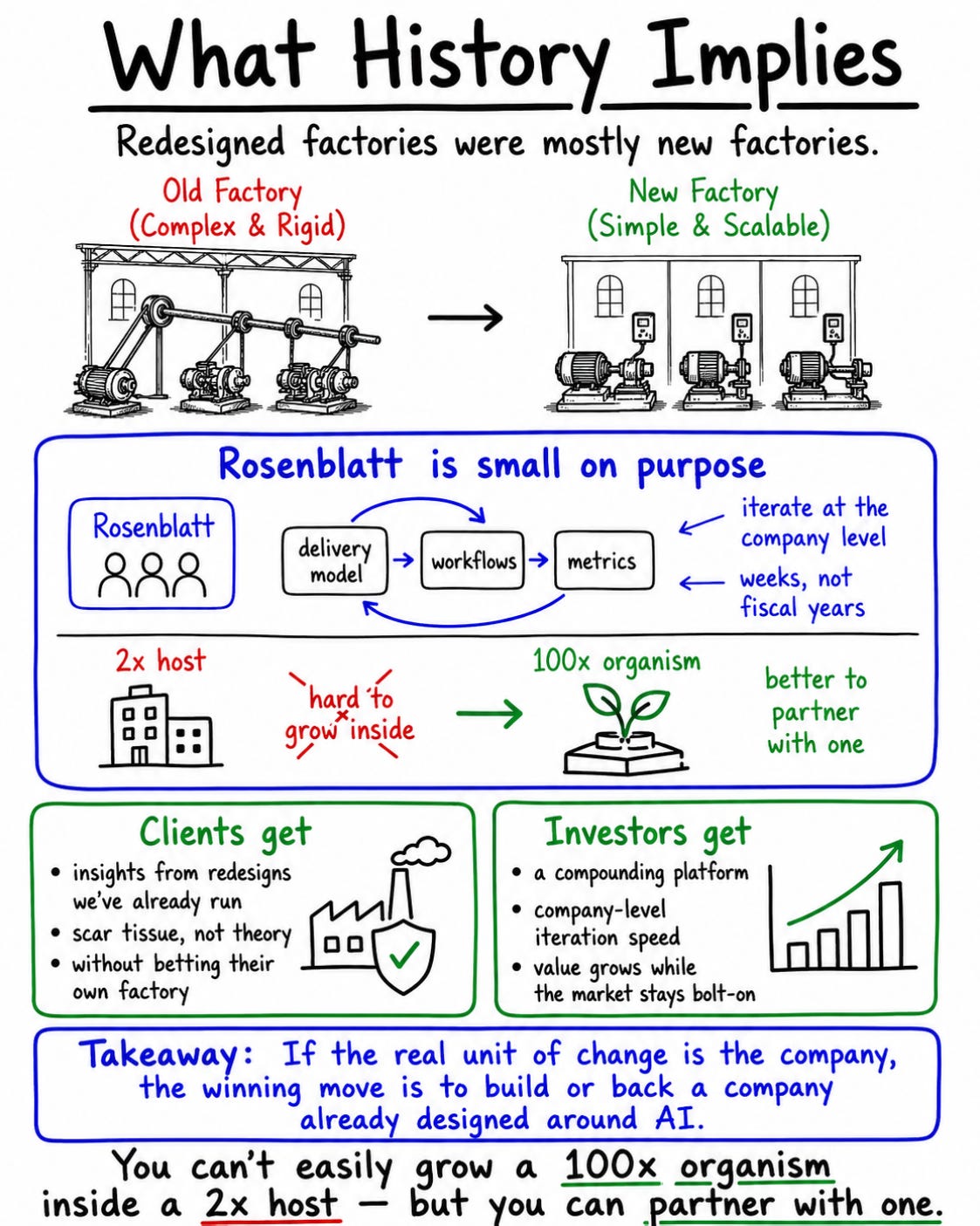
Why small is structural. Incumbents aren’t choosing the 2x paradigm out of a lack of imagination; they’re locked into it by scale, sunk process, and quarterly commitments.
History says redesigned factories were mostly new factories. Rosenblatt is small on purpose: we iterate at the company level (delivery model, workflows, metrics) in weeks, not fiscal years. You can’t easily grow a 100x organism inside a 2x host, but you can partner with one.
Clients get insights that are scar tissue from redesigns we’ve already run, without betting their own factory.
Investors get an asset (compounding platform plus company-level iteration speed) that appreciates precisely because the market stays stuck in bolt-on mode.
Who drives it. The heroes of the 1920s weren’t electricians; they were industrial engineers who understood both the motor and the factory. Today’s equivalent is the systems engineer with AI and full-stack depth: someone who understands the models, the software, and the business system around both. They will be the primary drivers of the new model of company. Rosenblatt is where that kind of engineer is battle tested.
The brief. The electric motor was available for thirty years before the world realized the factory, not the motor, was the point. AI has been commercially available for about three. Everyone will adopt the engine. The only question is bolt-on or built-around, and how long you take to learn the difference. We’ve made our choice. If you want to see a company built around the engine, as a client, partner, or investor let’s talk.