


When UScope needed to replace manual, photo-by-photo damage review with an automated report pipeline for insurance field inspectors, Rosenblatt built and shipped an AI captioning service end to end: OpenAI-powered damage detection, room-level aggregation, and PDF report generation. We cut response time for a 100-image report from 5 minutes to 8 seconds, and the production pipeline processes full 335-image assignments, generating 27 room-level summaries, in about 30 seconds at a cost as low as $0.0004 per caption.
Initial Consultation
Rosenblatt scoped a project for UScope, a property-damage inspection platform: give field inspectors a way to upload a batch of on-site photos, then use OpenAI's vision models to read every image and generate a complete damage report automatically. UScope handed over example assignment JSON and a detailed "scope checklist" for the report format, and Rosenblatt built the pipeline from the ground up.
Automated Damage Reports
Rosenblatt built the pipeline from the ground up: ingest the assignment JSON, enrich it with third-party data (like the property's year built), pass every photo to OpenAI to detect and describe damage, aggregate the results by room using each image's file path, and summarize everything into a single structure-wide report — covering details like roof pitch and the specific type of roof damage (granule loss, thermal cracking, etc.) — before generating the final PDF exactly to UScope's spec. The system runs on AWS: a FastAPI service handles requests and preprocessing, while an async Lambda function fans out the image calls to OpenAI in parallel, cutting response time for a 100-image report from 5 minutes down to just 8 seconds.
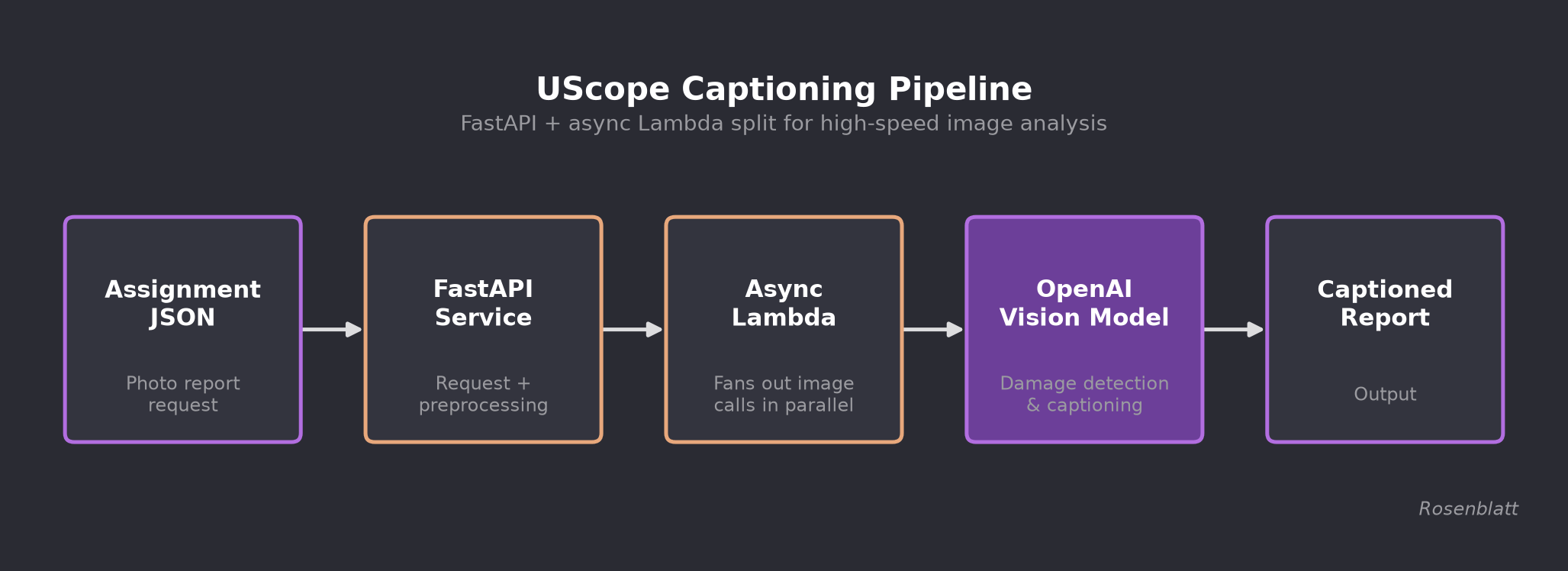
At full scale, the service can caption 335 images and generate 27 assignment summaries in about 30 seconds, at a cost as low as $0.0004 per caption — one real UScope assignment ran 168 images through the pipeline in a single batch. The hardest technical problem wasn't the pipeline logic, it was throttling: managing OpenAI's rate limits at that volume while keeping the whole batch fast. The team also had to rebuild around a client-side data breach that corrupted the first set of example images. A functional prototype was ready in two weeks, followed by two to three more weeks iterating on the exact PDF layout UScope wanted.
The captioning service was handed off production-ready: the FastAPI + Lambda pipeline running end-to-end against UScope's live assignment data, from image upload through to a finished damage report PDF.
About Rosenblatt
MIT reports that partnering externally on AI-first products brings them live 6 months sooner and twice as successfully as internal builds. Rosenblatt specializes in AI transformation for mid-market, tech-enabled, professional services. We bring together AI leaders from big 4 consulting firms and founders from exited AI startups to lead companies from fast pilots to complete AI transformations. Click below to schedule a 30-minute meeting with our CEO and founder.