

TL;DR
I’ve included whiteboard images below to make the big blocks of text easier to digest, focusing on FDPE’s, Private Equity, and Startup Founders as an audience.
We’re in a massive paradigm shift
Paradigm shifts require a Research & Development (R&D) approach
Consultant FDPEs are uniquely suited to execute R&D with Clients, because they learn the macro lessons across clients and are closest to the actual users
The role of Software Engineer is transforming into FDPE because execution is increasingly being handled by capable systems
Feedback loops define success or failure for all software endeavors
Execution was never the hard part of Engineering, building the right thing is the hard part, and embedded product-focused engineers have tight feedback loops
What FDPEs Need to Know
The role sits at the intersection of an embedded consultant and a product engineer who can operate probabilistic systems, and in mid-2026 three skills carry the weight.
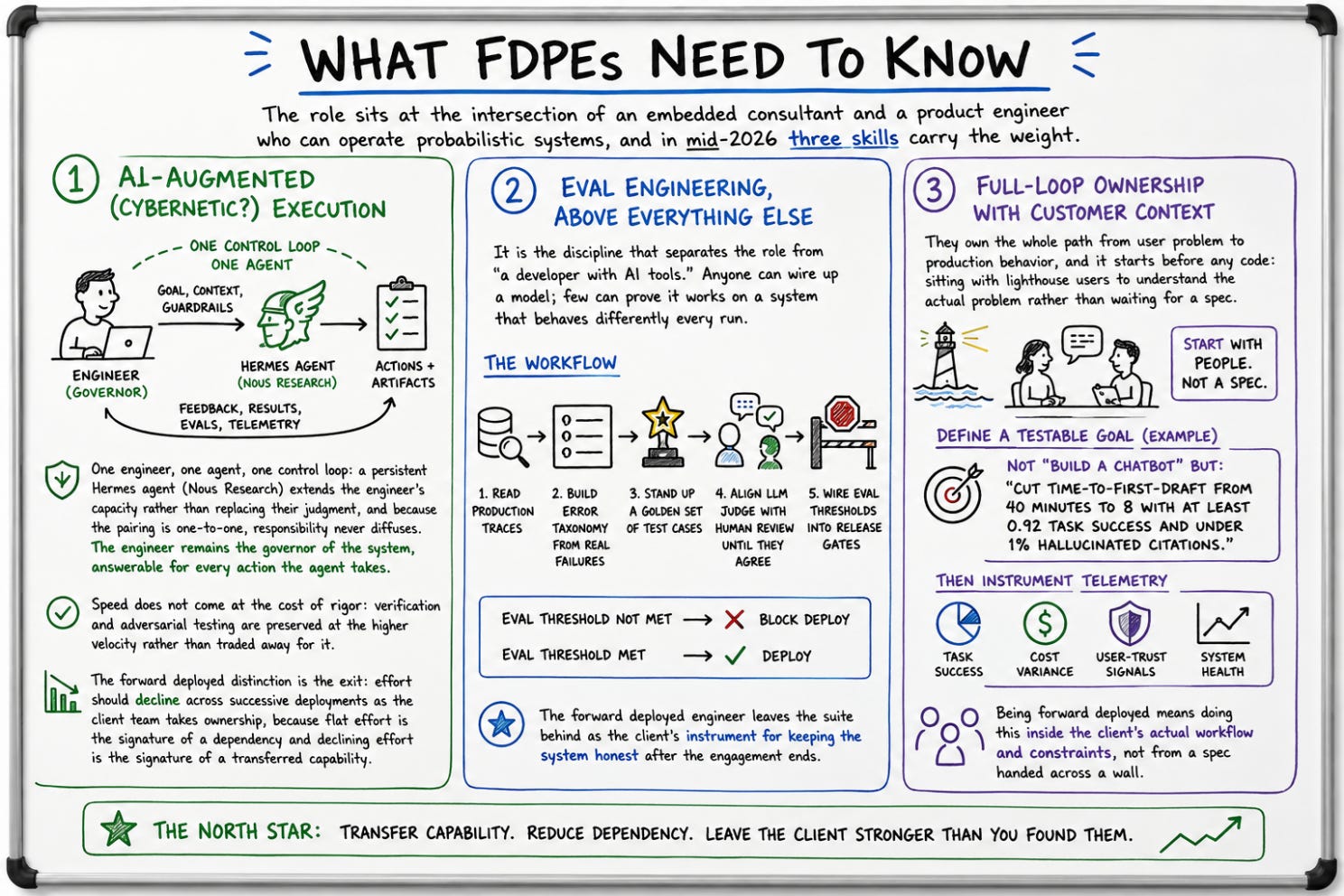
AI-augmented (Cybernetic?) Execution
One engineer, one agent, one control loop: a persistent Hermes agent (Nous Research) extends the engineer’s capacity rather than replacing their judgment, and because the pairing is one-to-one, responsibility never diffuses. The engineer remains the governor of the system, answerable for every action the agent takes.
Speed does not come at the cost of rigor: verification and adversarial testing are preserved at the higher velocity rather than traded away for it.
The forward deployed distinction is the exit: effort should decline across successive deployments as the client team takes ownership, because flat effort is the signature of a dependency and declining effort is the signature of a transferred capability
Eval Engineering, above Everything Else
It is the discipline that separates the role from “a developer with AI tools.” Anyone can wire up a model; few can prove it works on a system that behaves differently every run.
The workflow is concrete: read production traces, build an error taxonomy from real failures, stand up a golden set of test cases, align an LLM judge with human review until they agree, and wire eval thresholds into release gates so a regression blocks a deploy.
The forward deployed engineer leaves the suite behind as the client’s instrument for keeping the system honest after the engagement ends.
Full-loop Ownership with Customer Context
They own the whole path from user problem to production behavior, and it starts before any code: sitting with lighthouse users to understand the actual problem rather than waiting for a spec.
The job is to define a testable goal, not “build a chatbot” but “cut time-to-first-draft from 40 minutes to 8 with at least 0.92 task success and under 1% hallucinated citations,” then instrument telemetry so the shipped system reports task success, cost variance, and user-trust signals.
Being forward deployed means doing this inside the client’s actual workflow and constraints, not from a spec handed across a wall.
What Private Equity needs to Know
The forward deployed AI product engineer is the unit of real AI capability inside an asset, and the same three skills that define the role map directly onto three things a buyer underwrites: whether the AI is provable, whether it is tied to a business outcome, and whether the capability stays with the company after the check clears.
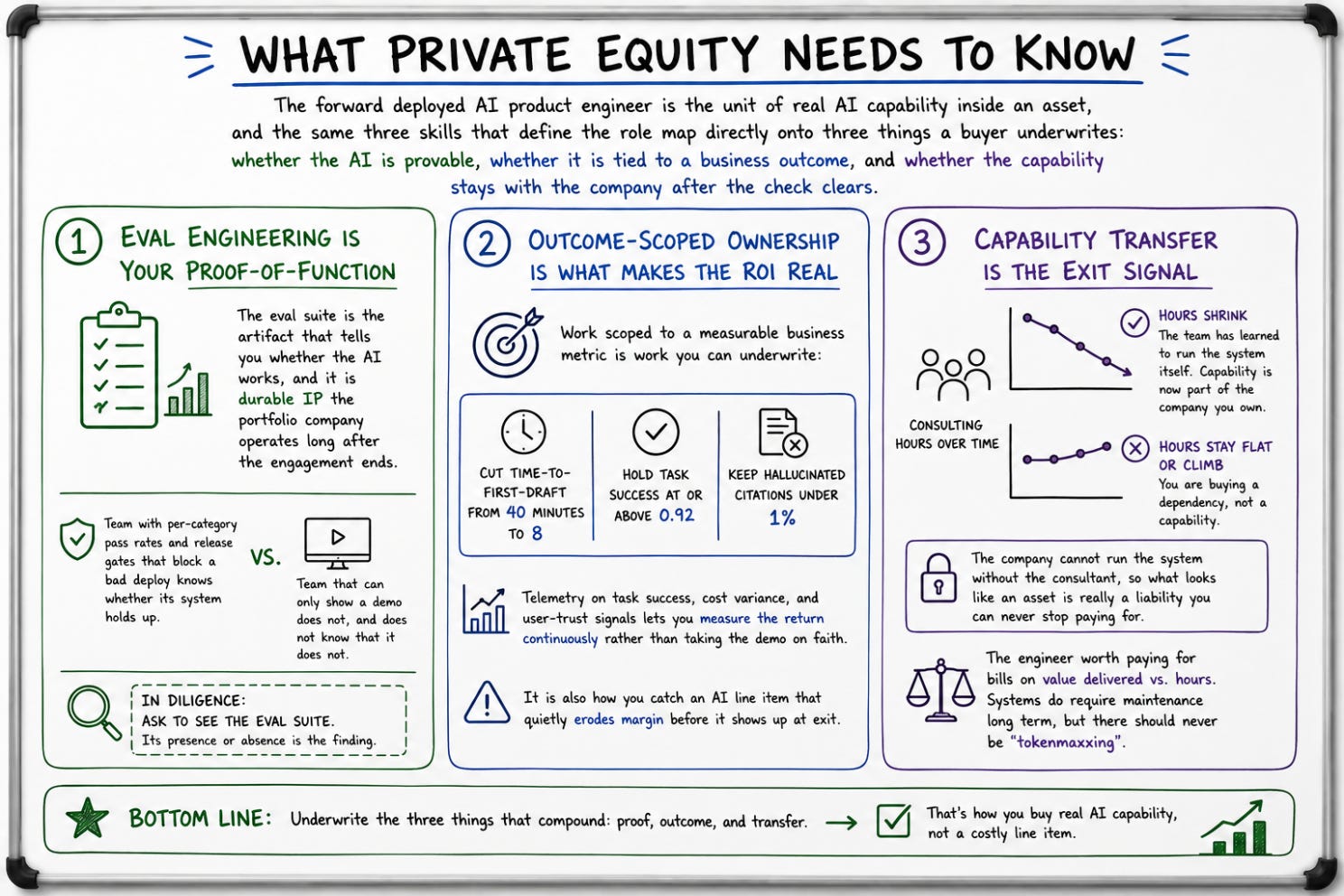
Eval Engineering is your Proof-of-Function
The eval suite is the artifact that tells you whether the AI works, and it is durable IP the portfolio company operates long after the engagement ends.
A team with per-category pass rates and release gates that block a bad deploy knows whether its system holds up; a team that can only show a demo does not, and does not know that it does not.
In diligence, ask to see the eval suite. Its presence or absence is the finding.
Outcome-scoped Ownership is what makes the ROI Real
Work scoped to a measurable business metric is work you can underwrite: cut time-to-first-draft from 40 minutes to 8, hold task success at or above 0.92, keep hallucinated citations under 1%. “Build a chatbot” is not.
Telemetry on task success, cost variance, and user-trust signals lets you measure the return continuously rather than taking the demo on faith.
It is also how you catch an AI line item that quietly erodes margin before it shows up at exit.
Capability Transfer is the Exit Signal
Watch how the consulting bill changes over time. If the hours shrink with each project, the team has learned to run the system itself, and that capability is now part of the company you own.
If the hours stay flat or climb, you are buying a dependency, not a capability. The company cannot run the system without the consultant, so what looks like an asset is really a liability you can never stop paying for.
The engineer worth paying for bills on value delivered vs. hours. Systems do require maintenance long term, but there should never be ‘tokenmaxxing’.
What Startup Founders need to Know
The forward deployed AI product engineer is the role that turns “we use AI” into AI your customers actually trust, and for a founder the same three skills answer three questions: can you ship AI that works, is it moving a number that matters, and will your own team own it before the cash runs out.
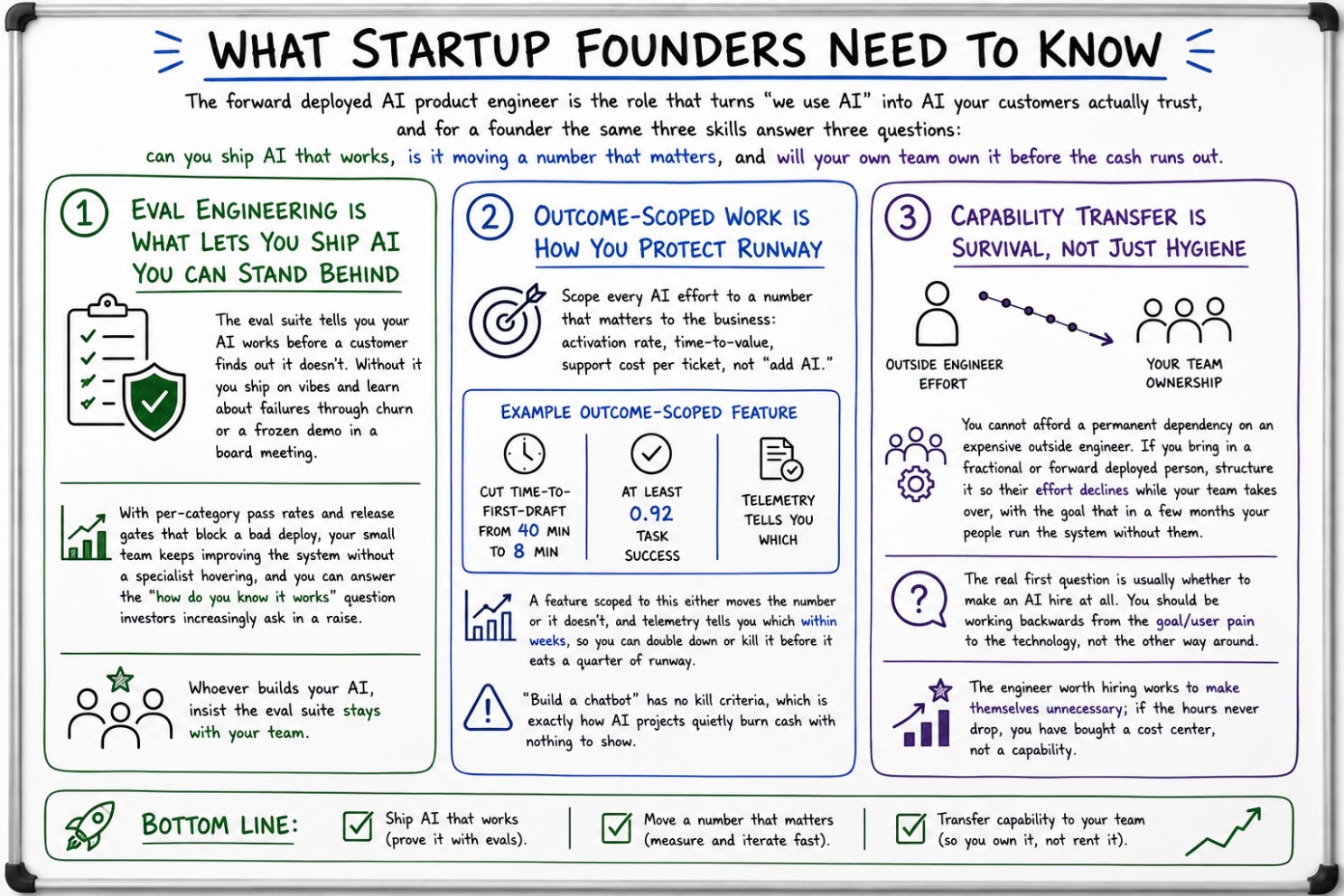
Eval Engineering is what lets you Ship AI you can Stand Behind
The eval suite tells you your AI works before a customer finds out it doesn’t. Without it you ship on vibes and learn about failures through churn or a frozen demo in a board meeting.
With per-category pass rates and release gates that block a bad deploy, your small team keeps improving the system without a specialist hovering, and you can answer the “how do you know it works” question investors increasingly ask in a raise.
Whoever builds your AI, insist the eval suite stays with your team.
Outcome-scoped work is how you Protect Runway
Scope every AI effort to a number that matters to the business: activation rate, time-to-value, support cost per ticket, not “add AI.”
A feature scoped to “cut time-to-first-draft from 40 minutes to 8 at 0.92 task success” either moves the number or it doesn’t, and telemetry tells you which within weeks, so you can double down or kill it before it eats a quarter of runway.
“Build a chatbot” has no kill criteria, which is exactly how AI projects quietly burn cash with nothing to show.
Capability Transfer is Survival, not just Hygiene
You cannot afford a permanent dependency on an expensive outside engineer. If you bring in a fractional or forward deployed person, structure it so their effort declines while your team takes over, with the goal that in a few months your people run the system without them.
The real first question is usually whether to make an AI hire at all. You should be working backwards from the goal/user pain to the technology, not the other way around.
The engineer worth hiring works to make themselves unnecessary; if the hours never drop, you have bought a cost center, not a capability.
Conclusion
The forward deployed engineer, the PE buyer, and the founder are asking the same three questions in different dialects: can you prove the AI works, is it moving a number that matters, and does the capability stay when the engineer leaves. Evals answer the first, outcome-scoping answers the second, and capability transfer answers the third.
That convergence is not an accident. We are early in a paradigm shift, and in a paradigm shift execution is the part that gets cheap first. Capable systems now write most of the code, which means the old proxies for engineering value, shipping fast, writing a lot, looking busy, have stopped carrying information. What does not get cheap is knowing whether the thing works, knowing it is the right thing, and making sure the people who own it can keep it running. Those are feedback-loop problems, and they were always the hard part. Execution was never the bottleneck. Building the right thing was.
The forward deployed AI product engineer is the role that forms around that truth. They sit closest to the user, run the tightest feedback loop, and carry the macro lessons from one client to the next, which is exactly the posture R&D demands when nobody yet knows the right answer. For the founder, that is who you hire, or deliberately decide not to. For the PE buyer, that is the capability you are underwriting. For the engineer, it is the work worth getting good at, because it is the part the machine does not do for you.
The model can write the code. It cannot tell you whether the code was worth writing. That gap is the job.